By Steve Roark
Volunteer, Cumberland Gap National Historical Park.
Confession time: I am not good at math.
I use it, it’s great, we went to the moon with it, yada yada. But I don’t think well mathematically and strive to understand it. But I was amazed to discover that trees use mathematics to arrange their leaves on a twig to optimize their collection of sunlight for the photosynthesis thing. Leonardo da Vinci picked up on this long ago. The “impress your friends” word of the day is phyllotaxis: the arrangement of leaves on a stem in relation to each other.
Trees arrange their leaves in three major ways: whorled, opposite, and alternate. Whorled is where several leaves encircle the stem at one point, which is uncommon. Opposite is where the leaves are arranged in opposing pairs on each side of the twig. Dogwood, all the maples, ash and buckeye use this arrangement. Usually, each successive pair of opposing leaves forms at right angles to the original pair, thus minimizing shading each other from the sun.
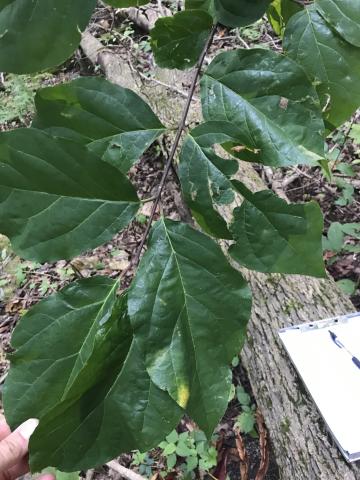
The math really starts kicking in with the alternate leaf arrangement, which I used to define as leaves forming on the twig randomly and not in pairs―but they are not random. With alternate arrangement the leaves form in a spiral along the twig, and how many leaves form per complete spiral is predictable by species.
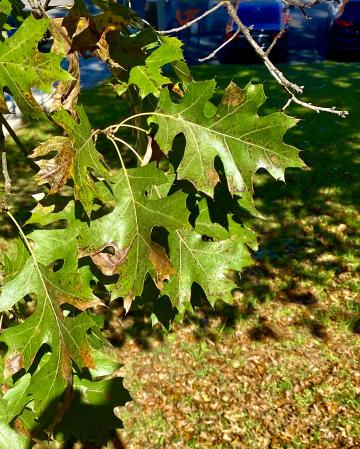
Imagine you have a tree twig in your hand; focus on one leaf and its location; from that leaf start counting leaves along the twig and how many turns around the twig it takes to return to a position matching the original leaf but further along the branch. For example, if you are looking at sycamore, you will count two leaves with one turn around the stem. With cherry, you will count three leaves and two turns around. Oaks and a bunch of other hardwoods have a 2/5 arrangement: 2 turns around the stem in 5 leaves. There are other spiral leaf arrangement ratios as well: 1/3, 3/8, 5/13 and so on.
But there is a common thread in all of them in that they are all Fibonacci numbers, named after a mathematician who figured them out in the 13th century. I know it is getting a little deep but hang with me. Fibonacci numbers include the sequence 1, 2, 3, 5, 8, 13, 21, etc. Note that when you add two numbers in the sequence together, they add up to the next highest number.
So if you look, 1+2=3, 2+3=5, 3+5=8, and so on. Interesting yes, but what is critical about Fibonacci numbers is the ratio between them. If you divide a Fibonacci number by the next highest number, it will be 0.618034 times as large as the number that follows. The Greeks called this ratio the “golden mean” because the proportion 0.618034 to 1 is the mathematical basis for almost all spirals in nature: leaves spiraling up a twig, the arrangement of bracts on a pine cone, sunflower seed arrangement on the flowerhead, even the spiral of a snail shell.
What it boils down to is that in nature, a spiral based on Fibonacci numbers is a very efficient design form, and in the case of trees it minimizes how much each leaf shades another, meaning better sunlight collection and thus more food production. So next time you are in the woods, keep in mind that there is purpose in almost everything you observe. This is both awesome and humbling.