Tree Leaves
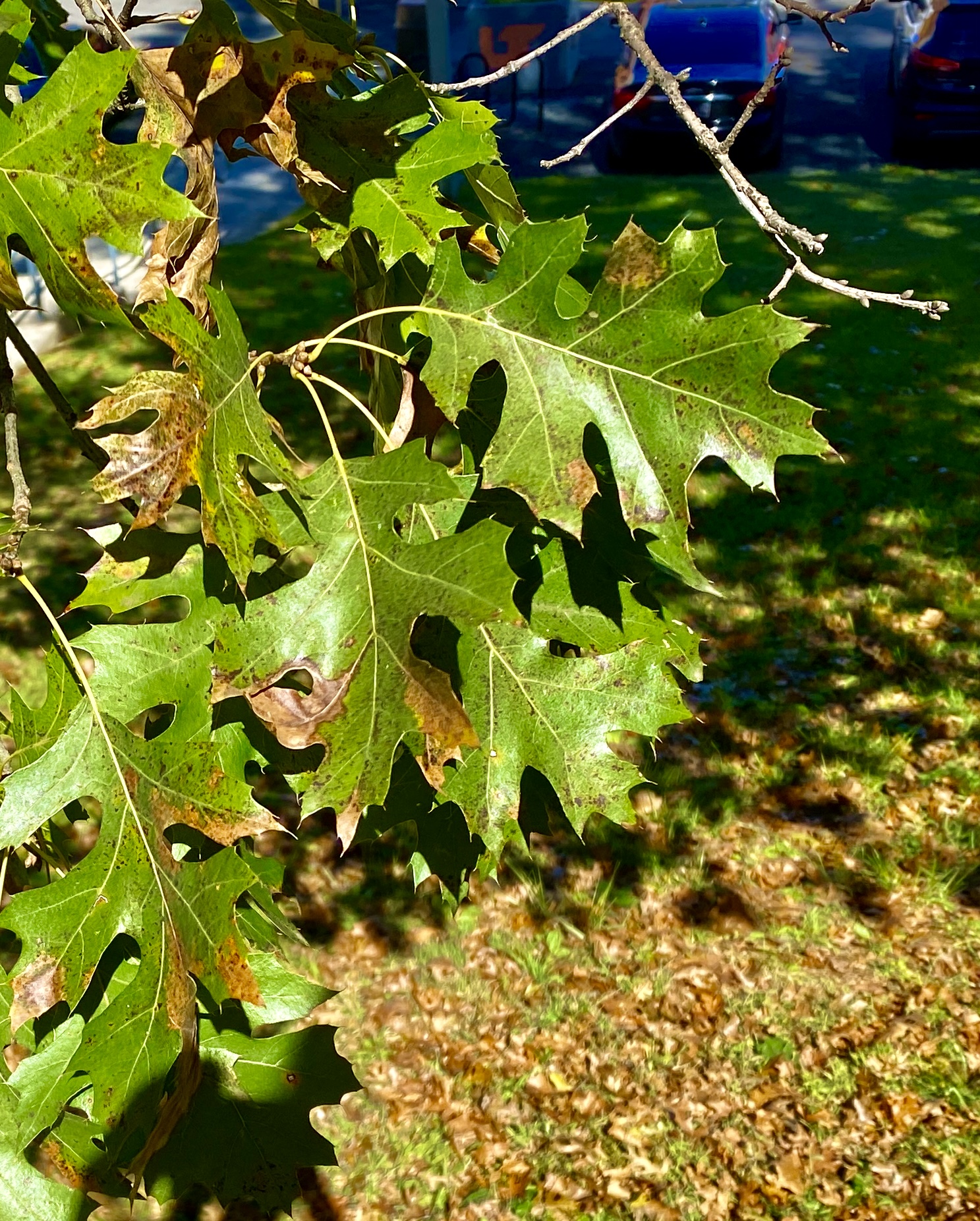
By knowing what to look for, leaves can be used to identify tree species. These are oak leaves, which have extended lobes that may be sharp or rounded.
By Steve Roark
Volunteer Cumberland Gap National Historical Park
When it comes to trees, we live in a blessed place, with more varieties of trees, shrubs and vines than anywhere in the world except maybe the tropics. Each tree and shrub has its own unique leaf that, with a little practice, will allow you to identify it.
The main feature to look for in leaf identification is shape. There are star shapes (sweetgum, maples), heart shapes (redbud), fat round ones (dogwood), and long skinny ones (willow). The most common shape is called “lanceolate” or spear shaped. Beech, sourwood, and elm have it. Some trees have complex shapes with finger-like extensions called “lobes” separated by spaces called “sinuses.” Oaks and maples have these features.
Something else to look for is the type of leaf margin. Some leaf edges are smooth, while others are serrated, having saw-toothed edges. The teeth vary in size and number between different tree species.
Another key feature is whether the leaf is “simple,” made up of a single blade, or “compound,” made up of three or more “leaflets.” The way to tell the difference is to see where the leaf stem attaches to a twig with bark and buds. If the stem of a single leaf blade attaches to a barked twig, then it's simple. If the leaf stem is attached to a soft green “twig” with no bark, then it's probably a leaflet of a compound leaf. Everything from the barked twig out is technically a single leaf. Black walnuts have very long leaves over two feet in length and made up of 15 to 25 leaflets. All the hickories have a compound leaf with 5-9 leaflets. Other trees with compound leaves include ash, boxelder, buckeye and black locust.
One other important feature to look for is whether the leaves attach to the barked twig in opposing pairs (called opposite branching), or singly (called alternate branching). The most common trees in our area with leaves that occur opposite include ash, boxelder, buckeye, dogwood and all of the maples.
The best way to learn tree leaves is to invest in a good reference book and start observing leaves out in the woods. A good book is the Field Guide to Trees of the Eastern US, published by the Audubon Society. It has good color photos of leaves and breaks their identification down by shape, leaf margins, etc. It’s available at most bookstores and online.

- Log in to post comments