Spooky Native Plants
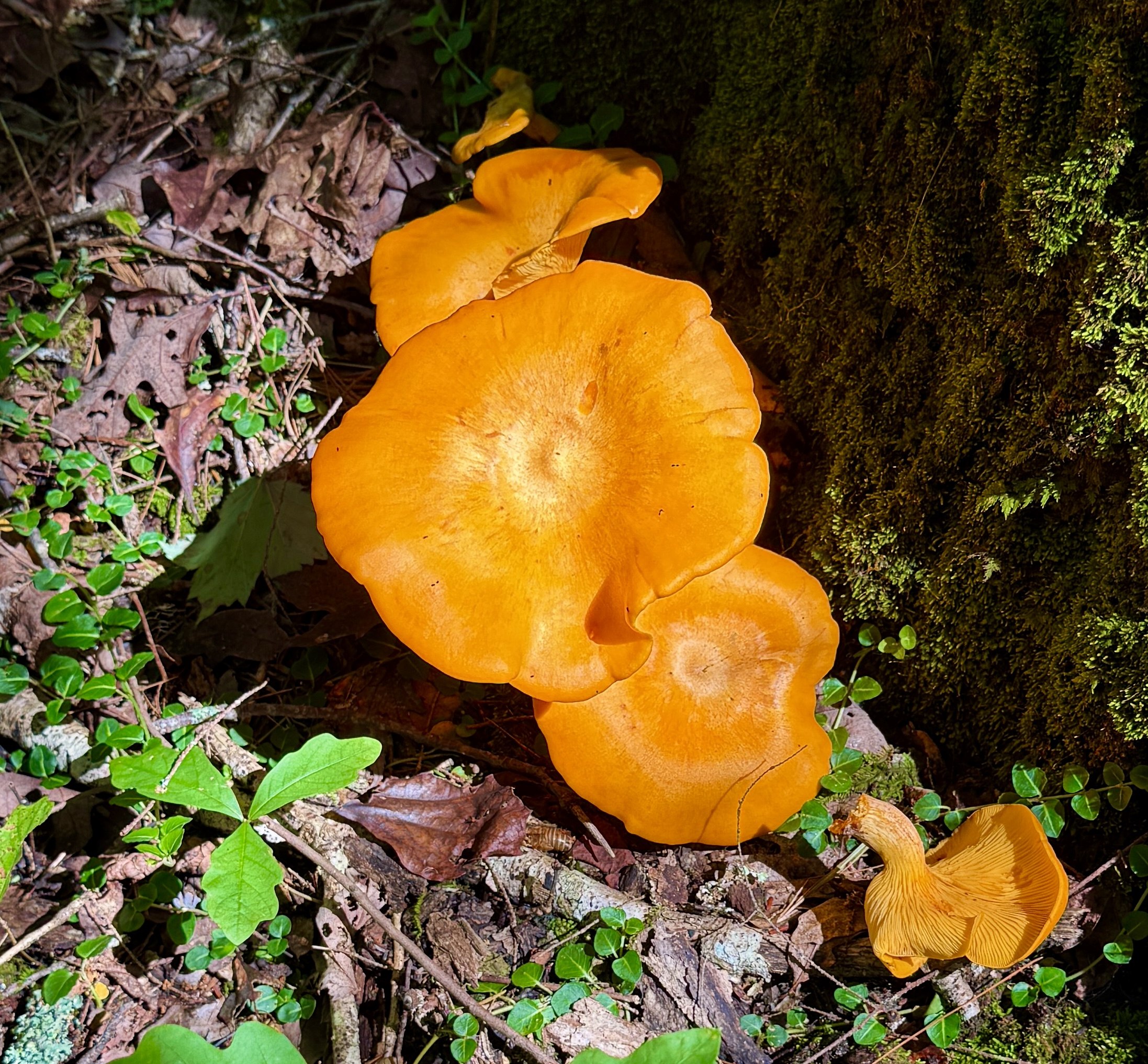
This Jack O Lantern mushroom is one of several local plants with eerie or spooky names.
By Steve Roark
Volunteer Cumberland Gap National Historical Park
I have always been curious about the origin of unusual plant names, and with a nod towards Halloween, I thought I would embark on local plants with ominous or spooky names. So here goes:
Bloodroot: This early spring flowering plant has a large daisy-like flower and odd shaped scalloped leaves. As the name implies the roots when broken emits a bloody looking fluid, which Native Americans used for body paint and as an insect repellent
Witch-hazel: Halloween sounding enough; however, the name is the only spooky thing about it. This native shrub got its name from the old English word “wice”, (pronounced “witch”), which means bendable or flexible. This made it a useful plant to use when dowsing (also called witching or divining) for water, where a forked stick is held and will bend over where a good water source is located.
Jack O-Lantern Mushroom: This plant jibes nicely with Halloween, with the bright orange color of its stem and cap, which also glow faintly in the dark (referred to as bioluminescence) when young. And oh yes, it is quite poisonous. It grows on dead and dying tree trunks.
Ghost Pipe: this very odd wildflower has a waxy stem that rises out of the ground and then bends over to form a crook. It is a very pale white, lacking the green chlorophyll for making food via sunlight. Instead, it is parasitic and feeds on tree sap. So, I suppose could be considered vampirish.
Dead Man’s Fingers: this mushroom has a form that does indeed look like the fingers of a hand lying on the ground and has a deathly gray color, reminiscent of an aged corpse. Quite creepy to see.
Death Cap Mushroom: This lives up to its name, being the most poisonous of all mushrooms; as little as half a mushroom can kill you. It is white and looks similar to several edible mushrooms, which is why it is responsible for 90% of mushroom-related deaths. It originated in Europe but can now be found in the eastern U.S.
Devil’s Walkingstick: This small understory tree has a straight trunk with whorls of very sharp thorns all along it; not one to grab while pulling oneself uphill in the woods, something I have painfully done. The crown is a whorl of leaves reminiscent of a palm tree.

- Log in to post comments