The Shoebox Ford: The Car that Changed Everything
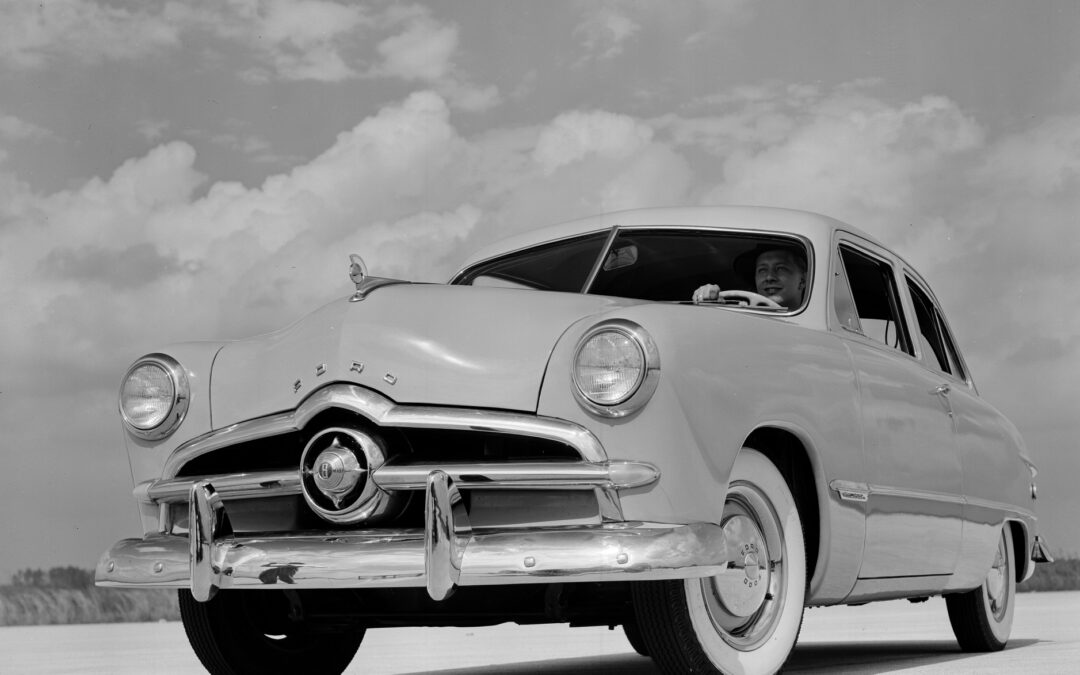
Timeless elegance on four wheels — this 1949 Ford cruises under open skies, capturing the bold optimism and clean, modern lines that defined postwar American design. With its iconic “shoebox” styling, wide stance, and gleaming chrome, it marked a new era for Ford and set the tone for the cars of the 1950s. (Image from Ford Motor Company)
In the years immediately following World War II, America was ready for something new. The country was booming, families were growing, and drivers wanted modern cars that reflected a new era of optimism and progress. In 1949, Ford Motor Company delivered exactly that with the introduction of the all-new Ford—now famously known as the “Shoebox Ford.” Produced from 1949 through 1951, the Shoebox Ford earned its nickname from its clean, slab-sided styling and squared-off roofline that resembled a shoebox. More importantly, it marked a major turning point for Ford, introducing a completely new body design that helped pull the company out of postwar stagnation and back into direct competition with Chevrolet and Plymouth.
The 1949 Ford was a bold departure from prewar styling. Gone were the rounded fenders and separate running boards. In their place was a sleek, modern body with smooth sides, integrated fenders, and a low, wide stance. It was one of the first truly modern American cars of the postwar era. Ford offered the Shoebox in several body styles, including two-door and four-door sedans, club coupes, convertibles and station wagons. The design was so fresh and appealing that Ford sold over one million cars in 1949 alone, a record at the time.
Under the hood, buyers could choose between two dependable engines: a 226 cubic inch L-head inline six or the legendary 239 cubic inch Flathead V8. The Flathead V8, already famous before the war, continued to be a favorite among hot rodders. Easy to modify, affordable and widely available, the Shoebox Ford quickly became a popular platform for speed equipment, dual carburetors, high-compression heads and custom exhaust systems.
The Shoebox Ford didn’t just dominate the streets—it became a force on the racetrack. In 1949, NASCAR held its first “Strictly Stock” race, and the Shoebox Ford proved to be nearly unbeatable. Between 1949 and 1951, Ford won 22 of the first 36 NASCAR Grand National races, cementing the model’s reputation as a true performance car straight from the factory. The combination of rugged construction, reliable Flathead V8 power, and aerodynamic styling gave Ford a clear advantage on the high-banked dirt and asphalt tracks of the era.
Beyond the racetrack, the Shoebox Ford earned a legendary reputation in the backroads and mountains of the American South as a favorite car of moonshiners and bootleggers. In Appalachia, from Tennessee and North Carolina to Virginia and Georgia, moonshine runners needed fast, durable cars that could haul heavy loads of illegal liquor over winding dirt roads while outrunning law enforcement. The Shoebox Ford proved to be the perfect tool for the job. Its strong frame, powerful Flathead V8, and roomy trunk made it ideal for hauling cases of moonshine, while its modern suspension and low stance helped it handle better than most cars of the era.
Moonshine runners often modified their Shoebox Fords with heavy-duty springs, reinforced shocks, hidden compartments, and hopped-up engines. Many cars were fitted with dual carburetors, straight pipes and upgraded brakes, turning ordinary family sedans into high-speed transport machines. These late-night runs through the hills and hollows helped sharpen the driving skills of many young racers who would later become legends of early stock car racing. In fact, much of NASCAR’s early talent pool came directly from moonshine country, where the Shoebox Ford had already proven itself under the toughest conditions imaginable.
Few cars have had a bigger impact on hot rod and custom culture than the Shoebox Ford. By the early 1950s, young enthusiasts were lowering them, chopping tops, shaving door handles, installing lake pipes and painting them in deep metallic finishes. The long, smooth body lines made them perfect for custom work, while the strong frame and V8 power made them ideal for drag racing and street performance. Even today, Shoebox Fords remain a staple at car shows, cruise-ins, and drag strips across the country.
The Shoebox Ford was more than just a successful model; it was the car that saved Ford Motor Company and redefined American automotive styling. It introduced a new generation to modern design, helped launch NASCAR into the national spotlight, and became a backbone of Appalachian moonshine culture. More than 75 years later, the Shoebox Ford still turns heads, fires up conversations and reminds us of a time when America was on the move and the open road symbolized freedom and opportunity. From the boulevard to the backstretch and the backroads of moonshine country, the Shoebox Ford remains one of the most influential cars ever built.
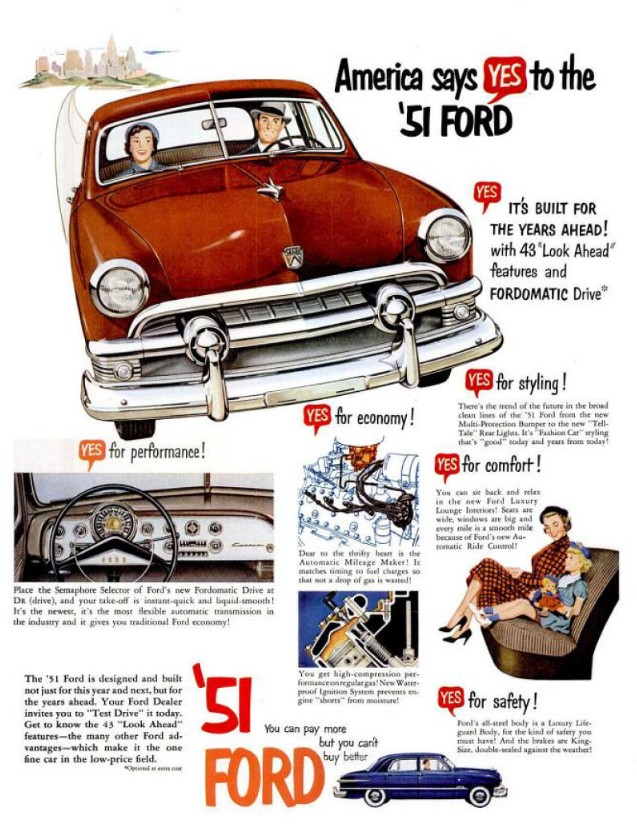
“America says YES to the ’51 Ford” — a bold celebration of style, comfort, performance, and innovation. With its sleek “Look Ahead” design and new Fordomatic Drive, the 1951 Ford promised a modern ride built for the years ahead. With bold chrome, jet-inspired lines, and innovative engineering, it embodied the excitement of a new decade and the promise that you could “pay more, but you can’t buy better.” (Image from Ford Motor Company)

- Log in to post comments