Pearl Harbor
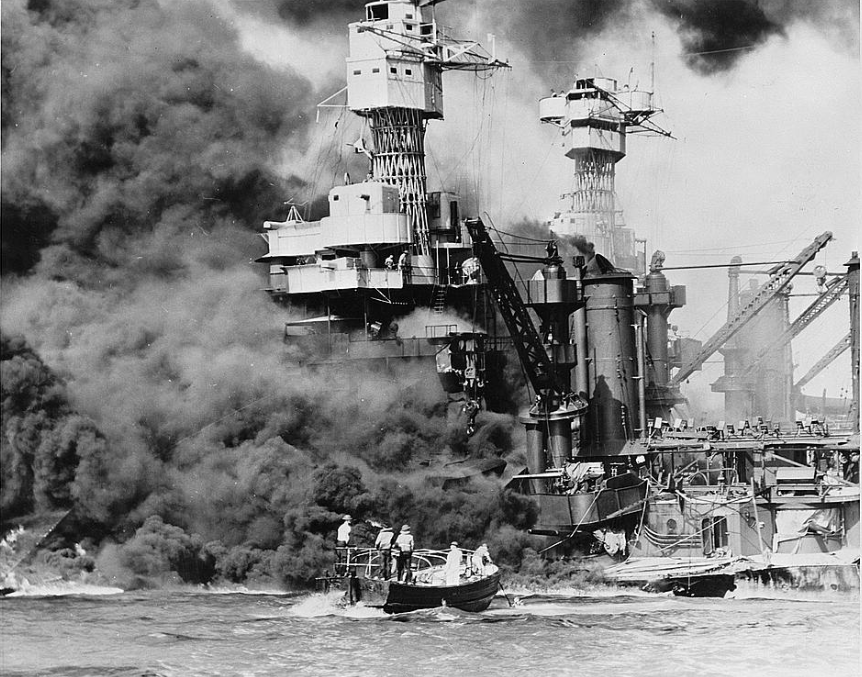
Pearl Harbor, Hawaii. A small boat rescues a seaman from the 31,800 ton USS West Virginia burning in the foreground. Smoke rolling out amidships shows where the most extensive damage occurred. Note the two men in the superstructure. The USS Tennessee is inboard
With the 84th anniversary of the Japanese attack on Pearl Harbor coming up, I found it appropriate to revisit the Japanese attack on the United States Naval Base Pearl Harbor in Hawaii on December 7th, 1941. This attack dragged the United States into World War II. According to the National Archives, “In a devastating defeat, the United States suffered 3,435 casualties and loss of or severe damage to 188 planes, 8 battleships, 3 light cruisers, and 4 miscellaneous vessels. Japanese losses were less than 100 personnel, 29 planes, and 5 midget submarines.” President Franklin D. Roosevelt would address the nation before a joint session of Congress, asking for a declaration of war against Japan. In his speech, he coined the iconic line of calling the attack on Pearl Harbor, “a day which would live in infamy.” Needless to say, Congress declared war on Japan. Instead of solely focusing on the attack on Pearl Harbor, I want to focus on the context leading up to the attack. So that leads to the question, why did the Japanese attack the United States?
The Japanese sought to expand their territory in the Asia-Pacific to gain resources and gain a market advantage. This goes back to the Age of Imperialism in the late 19th and early 20th centuries. European powers and the United States had territories in the Asia-Pacific region under their control, which they used for resources and better access to markets in the region. Japan, like the Western powers, also had a strong interest in controlling territories in the Asia-Pacific region for the same reasons the Western countries sought access to them. On top of that, Japan itself was in the Asia-Pacific region, so it had even more of a reason to want influence or control. However, this ultimately put Japan on the path to eventual conflict with the United States.
In 1931, Japan invaded Manchuria in Northern China, and they were successful in taking control, installing their own puppet government. According to the article The Path to Pearl Harbor, the Japanese renamed Manchuria to Manchukuo, but the United States refused to recognize Japan’s government in Manchuria under what is known as the Stimson Doctrine of 1932. The Stimson Doctrine was a direct response to Japanese aggression in Manchuria affirming the United States full support of Chinese sovereignty and denouncing Japanese aggression in the region. However, the Stimson Doctrine did not stop Japan from continuing its aggression towards China, and ironically, U.S. companies continued to do business with Japan, supplying them with steel and petroleum.
Although the United States was against Japanese aggression in Asia, it did not want direct conflict with Japan. A lot of this had to do with the isolationist movement within the United States, with the majority of the American public being disinterested in getting involved in a war not so close to home. There was also the fact that the United States was recovering from the Great Depression, which played into the isolationist movement. In 1940, President Franklin Roosevelt imposed an embargo on Japan that cut off shipments of scrap iron, steel, and aviation fuel, but oil shipments were still permitted. This, of course, changed when Japan invaded French Indochina with permission from German-occupied France, with which Japan had allied itself alongside Italy. In July 1941, Japan began to invade southern Indochina and prepared to attack British Malaya, which had resources like rice, rubber, and tin. They also planned to invade the oil-free Dutch East Indies.
In response, on July 26, 1941, President Franklin Roosevelt imposed another embargo on Japan, freezing all Japanese assets in the United States and effectively cutting off Japan’s access to U.S. oil. According to the article The Path to Pearl Harbor, “this finally pushed Japan to secretly begin what is known as the ‘Southern Operation,' a massive military attack that would target Great Britain’s large naval facility in Singapore and American installations in the Philippines and at Pearl Harbor, thus clearing a path for the conquest of the Dutch East Indies.” Diplomatic talks between the US and Japan continued, but no agreements were reached. On November 26th, 1941, as US officials presented the Japanese with a ten-point plan statement reiterating their long-standing position, the Japanese Imperial Navy ordered an large fleet of warships that included 414 planes aboard six aircraft carriers to set to sea, following a plan devised by Admiral Yamamoto Isoroku, who had earlier studied at Harvard and served as Japan’s naval attache in Washington, D.C. according to the article The Path to Pearl Harbor.
The goal was for a group of small boats to destroy the US-Pacific Fleet base at Pearl Harbor. According to the article The Path to Pearl Harbor, in order to catch the Americans by surprise, the ships maintained strict radio silence throughout their 3,500-mile journey from Hitokappu Bay to a predetermined launch sector 230 miles north of the Hawaiian island of Oahu. Then at 6:00 a.m. on Sunday, December 7th, the first wave of Japanese planes lifted off from the carriers, followed by a second wave an hour later. The pilots led by Captain Mitsuo Fuchida spotted land and assumed their attack positions around 7:30 am. Thirty minutes later, his bomber perched above American ships along Pearl Harbor’s “Battleship Row,” Fuchida broke radio silence to shout “Tora!, Tora!, Tora!,” which means “Tiger!, Tiger!, Tiger!,” the coded message informing the Japanese fleet that the surprise attack was successful.
According to the article The Path to Pearl Harbor, when the White House learned of the attack, President Franklin D. Roosevelt was finishing lunch and preparing to tend his stamp collection. He spent the remainder of the afternoon receiving updates and writing the address he intended to deliver to Congress.
In conclusion, Pearl Harbor is most remembered for the American lives lost and for dragging the United States into World War II, but the events leading up to Pearl Harbor are most often forgotten. The events leading up to Pearl Harbor are more detailed than what I could fit into this paper, but I hope that you, the readers, can take away something new with this information. I would encourage anyone interested in learning more about the attack on Pearl Harbor to visit the National Archives and the article The Path to Pearl Harbor from the National WWII Museum’s website, which is where most of the information, not based on my memory, used in this article comes from.
Bibliography
National Archives. “Attack on Pearl Harbor,” December 16, 2024. https://www.archives.gov/legislative/features/pearl-harbor.
The National WWII Museum. "The Path to Pearl Harbor" Published November 25, 2025. Accessed November 25, 2025. https://www.nationalww2museum.org/war/articles/path-pearl-harbor.
The National WWII Museum | New Orleans. “Pearl Harbor Attack, December 7, 1941,” December 7, 2001. https://www.nationalww2museum.org/war/topics/pearl-harbor-december-7-19….

- Log in to post comments