Japan during World War I
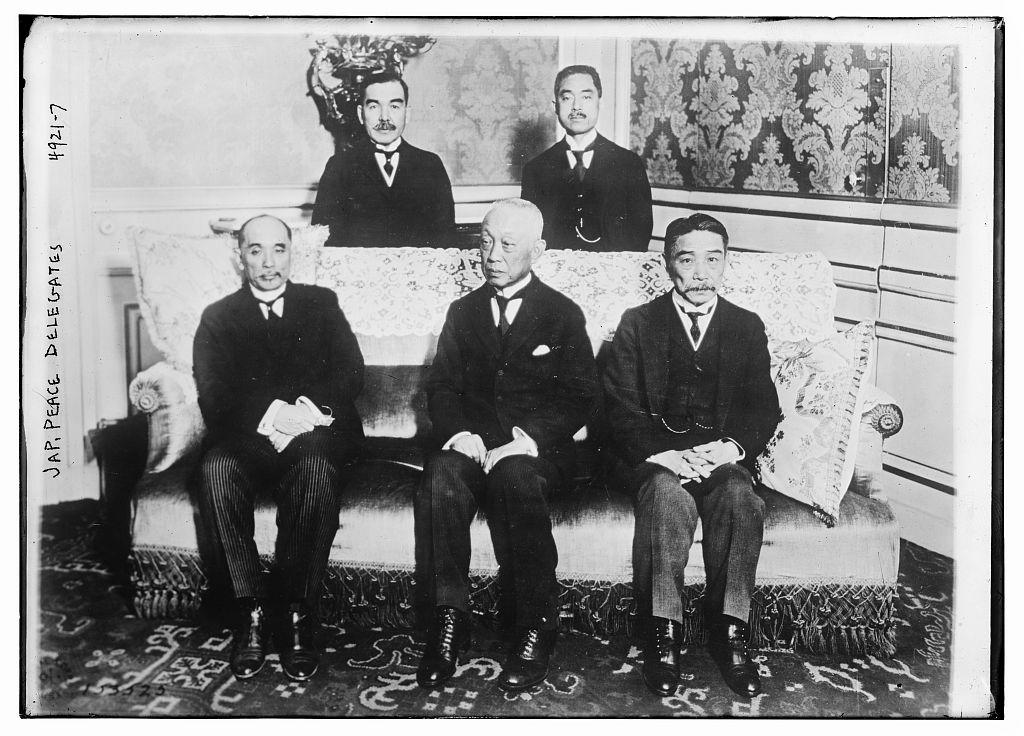
Photograph shows the Japanese delegates to the Paris Peace Conference in 1919. Standing (left to right): Ijuin Hikokichi and Matsui Keishiro; seated (left to right): Baron Makino Nobuaki, Prince Saionji Kinmochi and Viscount Chinda Sutemi. (Source: Flickr Commons project, 2017)
In the last article, we covered the Russo-Japanese War (1904–1905), which set the stage for Japan's involvement in World War I. Before turning to Japan’s role in the war, it is helpful to briefly review how the conflict began. World War I started on July 28, 1914, when Austria-Hungary declared war on Serbia after the assassination of Archduke Franz Ferdinand in Bosnia by a Serbian nationalist on June 28, 1914. Germany supported Austria-Hungary, while Russia backed Serbia. Europe was soon drawn into a kind of conflict it had never seen before. The Central Powers alliance consisted of Austria-Hungary, Germany, and the Ottoman Empire, while the Triple Entente, or Allied powers, consisted of Russia, France, and Great Britain.
How did Japan become involved in this conflict? As noted in the previous article, Great Britain and Japan were allies. On August 7, 1914, Great Britain requested that Japan attack German armored cruisers in Chinese waters. Although the alliance mainly applied to East Asia and did not require Japan to intervene in the war in Europe, Japan’s foreign minister, Katō Takaaki (1860–1926), was interested in joining the war to extend the lease that Japan had acquired in southern Manchuria after its victory in the Russo-Japanese War. Germany also held a lease in the Chinese province of Shandong. If Japan entered the war, it could drive Germany out of Shandong, return the province to China, and, in turn, secure an extension of its own lease in southern Manchuria.
On the other hand, Field Marshal Yamagata Aritomo opposed entering the war in Europe because he favored the Germans. Aritomo's preference for Germany is understandable because the modernization of the Japanese army in the late 19th century was modeled on the German army. He also wanted better relations with China because he believed that Japan would eventually go to war with Western powers. Takaaki's interest in joining the war prevailed, and on August 23, 1914, Japan declared war on Germany.
However, Japan’s involvement in conflict during World War I was limited. In fact, the Japanese did not believe that the war in Europe would last that long. Some even believed that the war would last only six months. The Imperial Japanese Navy captured Germany’s South Pacific Islands at the end of September and October 1914. The Imperial Japanese Army captured Qingdao City in Jiaozhou Bay, which is part of China's Shandong Province. Qingdao City fell on November 7, 1914. These two events were the only combat engagements in which the Japanese were involved in during World War I.
After the fall of Qingdao, Japan issued Twenty-One Demands to the Chinese government, which were initially rejected. In May 1915, Japan issued an ultimatum to China, and China accepted 16 of the 21 demands. Japan had achieved its main objectives in Asia and saw no benefit in deploying troops to Europe, but it did send some ships to the Mediterranean. Japan also supplied the Allies with materials, including copper and ammunition, and extended nearly 640 million in loans to the Allies. When Americans think of the war in the Pacific during World War II, they remember the Japanese as our enemies, but many do not realize that just two decades earlier, the Japanese were our allies.
World War I ended on November 11, 1918, with an armistice, and was formally concluded by the signing of the Treaty of Versailles on June 28, 1919. Japan benefited greatly from World War I. Japan transitioned from a primarily agricultural state to an industrialized state, expanding its influence on the world stage. Events in the two decades following World War I sowed the seeds for the end of Japan’s alliance with Great Britain and the United States. Much of this stems from the fact that Japan was not recognized as an equal among other global powers, such as the United States and Great Britain, after the war. Friction between the United States and Japan intensified as the United States sought to expand its influence in Southeast Asia and to limit Japan’s regional expansion, which ultimately led to Japan’s attack on Pearl Harbor on December 7th, 1941.
Sources
Aizawa, Kiyoshi, and Military History Department, National Institute for Defense Studies. 1997. The Shock of the First World War: Japan and Total War. Introduction. https://www.nids.mod.go.jp/english/event/symposium/pdf/1999/sympo_e1999….
Dickinson, Frederick R. 2013. “Introduction.” In World War I and the Triumph of a New Japan, 1919-1930. 1-12. Cambridge University Press.
———. 2013b. “World War 1 as Anchor.” In World War I and the Triumph of a New Japan, 1919-1930, 13–35. Cambridge University Press.
“Making Sense of the War (Japan) / 1.0 / Handbook - 1914-1918-Online (WW1) Encyclopedia.” 2024. 1914-1918-Online (WW1) Encyclopedia. July 9, 2024. https://encyclopedia.1914-1918-online.net/article/making-sense-of-the-w….
Schirokauer, Conrad. 1993. A Brief History of Japanese Civilization. Wadsworth Publishing Company.

- Log in to post comments