Japan’s Economic Bubble, the Lost Decade
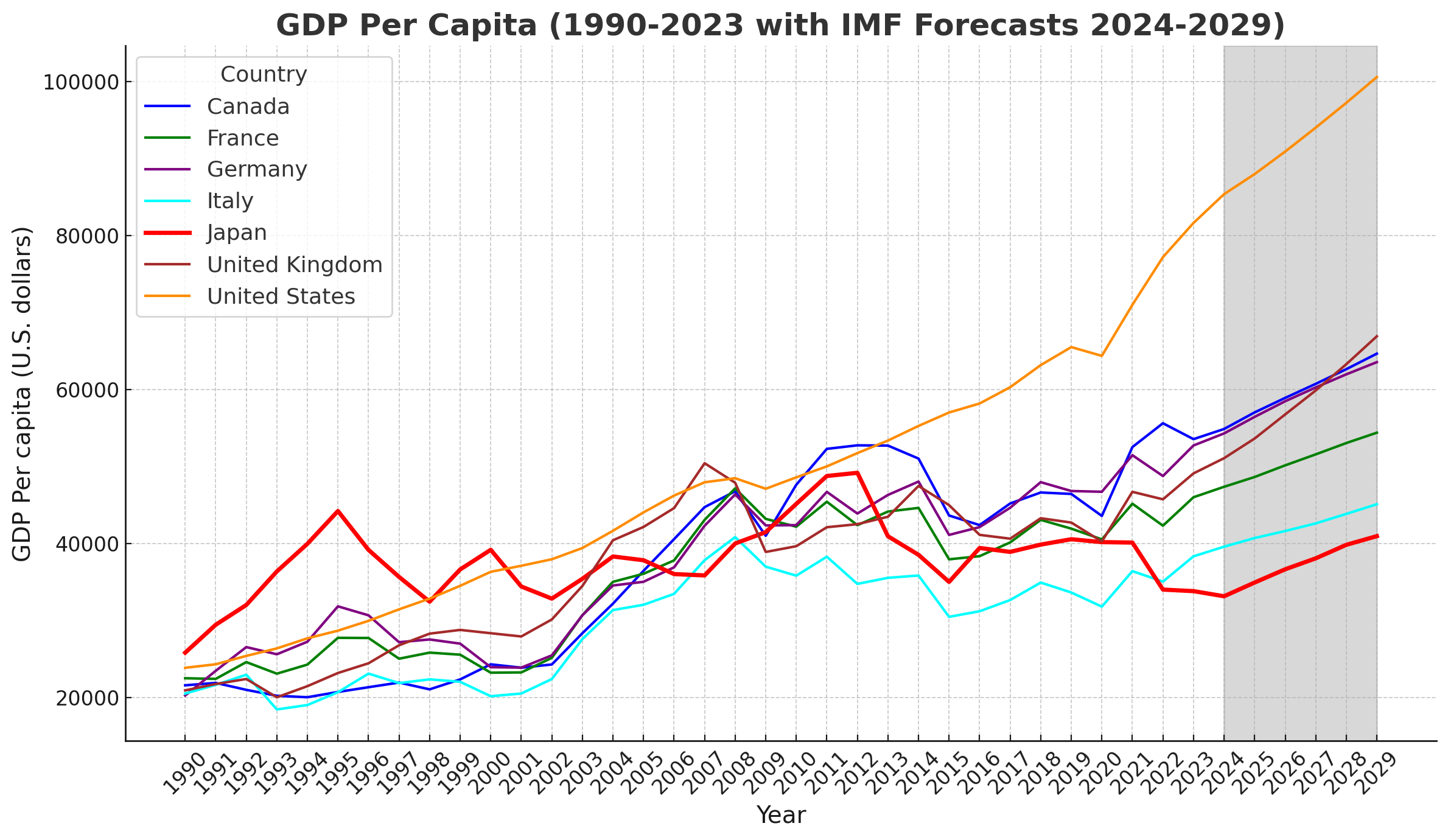
G7 Countries' GDP Per Capita, showcasing the differences in GDP growth from 1990 to 2029 - Wikimedia Commons
Japan's late-1980s and 1990s economic bubble led to one of the worst economic downturns in history. Before delving into this topic, it is important to define what an economic bubble is. According to the NASDAQ glossary, an economic bubble is “a market phenomenon characterized by surges in asset prices to levels significantly above the fundamental value of that asset.
Bubbles are often hard to detect in real time because there is disagreement over the fundamental value of the asset.” In the 1980s, Japan had the world’s second largest economy, but due to bad monetary policy from the Bank of Japan (BOJ), an economic bubble formed, eventually bursting in the early 1990s, leading to a recession and decades of economic recovery.
The decades of Japan’s economic stagnation are known as the Lost Decades, which, according to the writer Clay Halton from Investopedia, can be defined as “a time when the country's economy experienced slow growth and persistent deflation, impacting its financial stability and development.” So, the question is how did Japan get itself into the economic crisis of the Lost Decades? In this month’s article, I plan to explain in the simplest way possible the answer to that question.
In 1985, Japan, along with the United States, West Germany, France, and the United Kingdom, agreed to weaken the U.S. dollar by signing the Plaza Accord, causing the Japanese yen to rise sharply (Halton). This was done so that the United States could export more goods to other countries. The Plaza Accord was reversed in 1987 by the signing of the Louvre Accord after it had reached its intended effect to weaken the U.S. dollar and boost exports (Halton). However, this economic policy contributed to Japan’s economic bubble.
In response to the Plaza Accord, the BOJ cut interest rates to zero to offset the strong yen’s impact, flooding the economy with cheap credit. This led banks to expand lending, often to speculative projects, and collateral-driven loans fueled asset purchases (Halton). Japanese companies and individuals bought land and stocks on credit, believing prices would keep rising. By late 1989 Japan’s stock market index, the Nikkei 225, hit 38,915, and Tokyo’s Imperial Palace land was valued at more than all of California’s real estate, according to an article from The Economist.
The BOJ began to tighten monetary policy by raising interest rates and restricting lending because of rising real estate prices, which effectively burst the bubble that had formed around real estate and the stock market. In 1990 and 1991, the Nikkei 225 fell to about half its 1989 peak, and other asset prices began to collapse as well. Many loans were lent to assets and companies that did not perform, leading to bank failures and an even further decline in lending from the banks. These companies that did not perform well became what is known as “zombie companies.” Essentially, companies that were still in business only because banks were lowering interest rates and reducing the amount of debt they owed.
The collapse triggered deflation and low growth that continued for the remainder of the decade; this became what is known as the Lost Decade, when Gross Domestic Product (GDP) growth averaged around one percent, according to Charles Horioka's paper “The Causes of Japan’s ‘Lost Decade’: The Role of Household Consumption.” Many young adults, including college graduates entering the workforce, had difficulty finding employment because companies were unwilling to hire or to fire, given the economic circumstances of the time (Halton). As the value of the yen decreased, household consumption declined, worsening deflation.
The Lost Decade has now been labeled as the Lost Decades because the economic downturn continued into the 2000s and 2010s. Even after the economic bubble burst, Japan remained the world’s second-largest economy up until 2010, when it became the third-largest, being surpassed by China, and in 2024 when it became the fourth-largest, being surpassed by Germany, according to Yuri Kageyama in an Associated Press article. The government of Japan and its central bank tried to implement various economic policies to stimulate the economy to the same levels as the 1980s. It was not until this current decade of the 2020s that Japan has come close to returning to the same economic level it had during the 1980s.
In conclusion, the Japanese economic bubble of the late 1980s and 1990s is important because economists consider it an example and a warning about the dangers of cheap money, speculative investing, and overconfidence in asset price growth. In next month's article, I will cover the actions Japan took to try to recover its economy.
Sources
Chen, James. “Understanding the Plaza Accord: Impact on Global Currency Markets.” Investopedia. Updated April 14, 2026. https://www.investopedia.com/terms/p/plaza-accord.asp. (investopedia.com)
Horioka, Charles Yuji. The Causes of Japan’s “Lost Decade”: The Role of Household Consumption. NBER Working Paper No. 12142. Cambridge, MA: National Bureau of Economic Research, March 2006. https://www.nber.org/papers/w12142. (nber.org)
Kageyama, Yuri. “Japan Slips into a Recession and Loses Its Spot as the World’s Third-Largest Economy.” Associated Press, February 15, 2024. https://apnews.com/article/japan-economy-2023-gdp-893d53deba654c4924e49…
Nasdaq. “Economic Bubble.” Nasdaq Glossary. Accessed July 28, 2026. https://www.nasdaq.com/glossary/e/economic-bubble. (nasdaq.com)
The Economist. “Back from the Grave.” The Economist, October 11, 2007. https://www.economist.com/finance-and-economics/2007/10/11/back-from-th…. (fujisan.co.jp)

- Log in to post comments